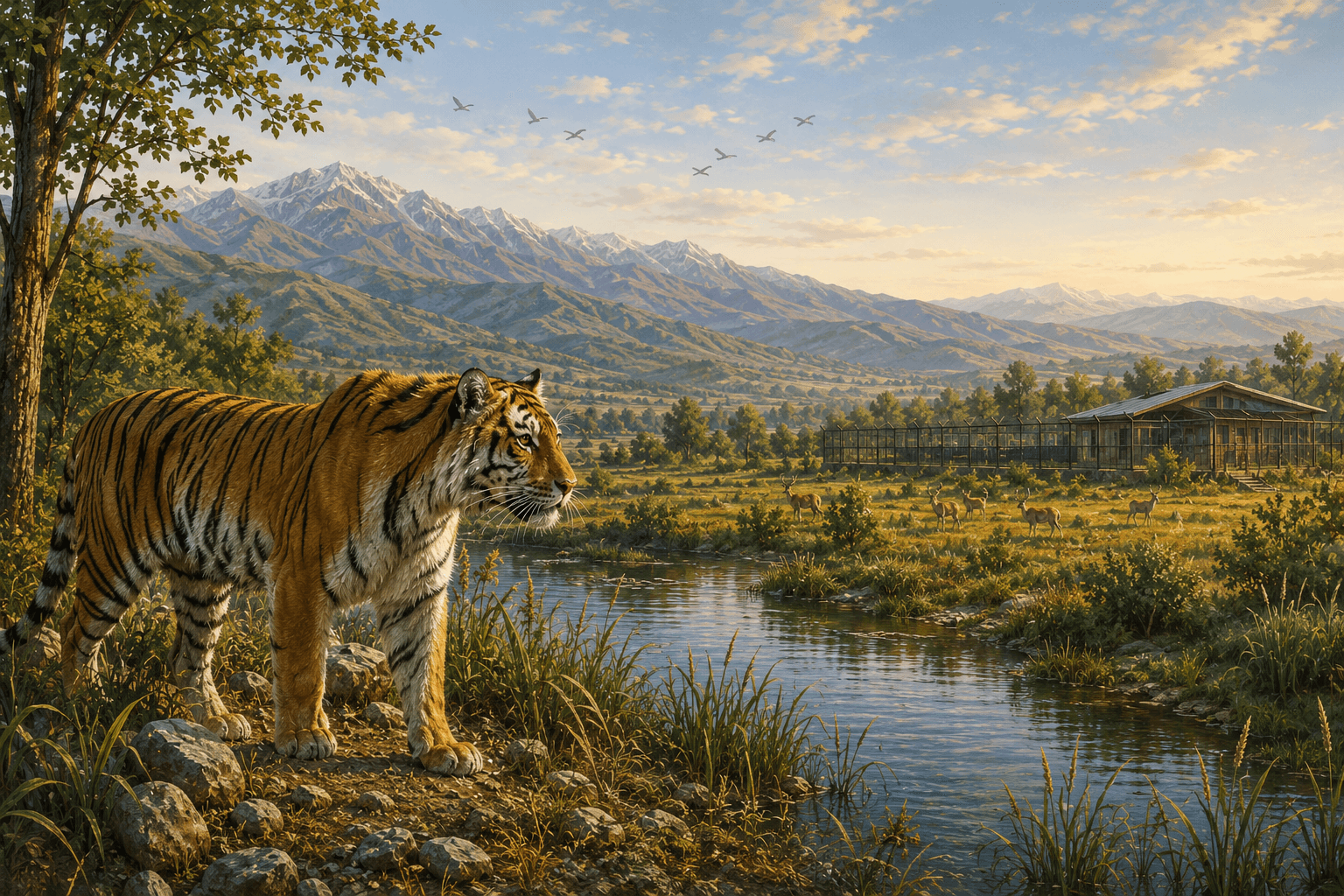
Tigers once lived across a vast stretch of Central Asia. The population commonly known as the Caspian tiger ranged through river valleys and wetlands from Turkey and Iran into Central Asia.
By the twentieth century, hunting, habitat loss and the disappearance of prey had pushed the animals toward extinction. Tigers disappeared from Kazakhstan decades ago, and the Caspian tiger was eventually declared extinct.
But genetic research later showed that Caspian and Amur tigers were extremely closely related. That opened an unusual conservation possibility: using Amur tigers to restore a tiger population to parts of the Caspian tiger's former range.
Kazakhstan chose the Ile-Balkhash region, an extensive landscape of wetlands, reed beds and forests surrounding the Ili River and Lake Balkhash.
The important part of the project began before the tigers arrived.
Kazakhstan established the Ile-Balkhash Nature Reserve and conservation organizations worked to restore habitat and increase populations of animals that could eventually support an apex predator.
That sequencing matters.
Reintroducing a predator without sufficient habitat or prey can simply create another conservation problem. A tiger that cannot find enough food is more likely to approach livestock and communities, increasing the risk to both people and the animal.
The Kazakhstan program is therefore trying to rebuild the ecological foundation first and introduce tigers into that recovering system gradually.
Tigers have now been brought into the program and are being managed through the reintroduction process.
If the effort succeeds, it would return a large predator to a landscape where tigers have been absent for roughly seven decades.
But success won't be measured by the arrival of a few animals.
It will be measured years from now—by whether released tigers can survive independently, find sufficient prey, coexist with nearby communities and eventually reproduce.
That's what makes the project worth following.
It isn't a story about declaring nature restored.
It's a story about doing the long work that might make restoration possible.