Independent editorial publication

Editions · September 6, 2026

The Good in the World

A clearer view of human progress.

Environment & Wildlife

Washington built crossings into a major interstate. Wildlife is actually using them.

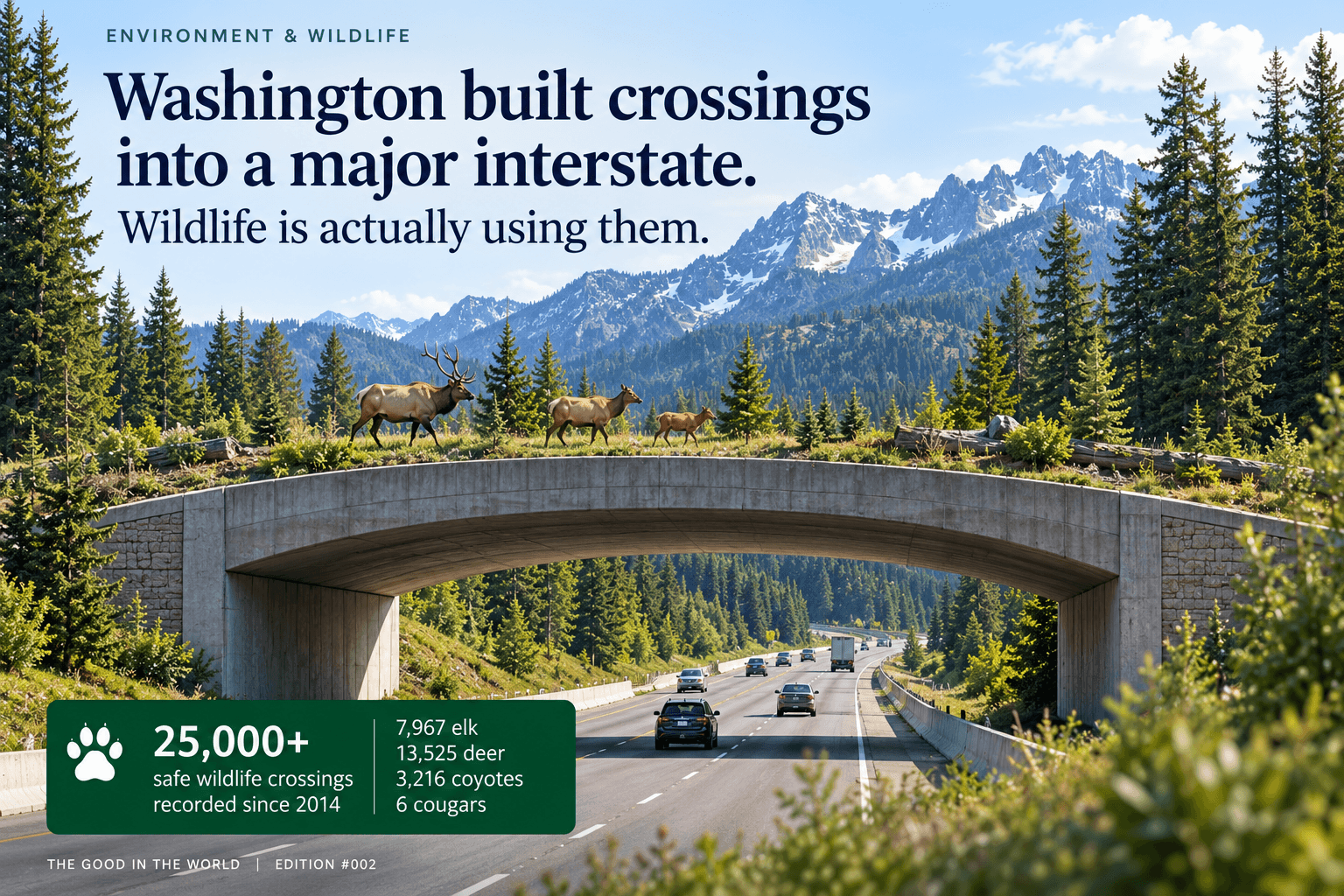
By the end of 2023, cameras had recorded more than 25,000 safe wildlife crossings at completed I-90 Snoqualmie Pass structures—including thousands of elk, deer and coyotes.

Editorial illustration of elk using a wildlife overpass above Interstate 90 in Washington's Snoqualmie Pass.
Editorial illustration. This image does not depict the actual event.

Washington State built wildlife overpasses, underpasses and fencing into the reconstruction of I-90 through Snoqualmie Pass—and animals are using them at scale.

By the end of 2023, cameras had recorded more than 25,000 safe crossings at completed structures since 2014, including 7,967 elk, 13,525 deer, 3,216 coyotes and six cougars.

A major highway can function like a wall through an ecosystem.

Animals trying to reach food, mates or seasonal habitat face traffic, while drivers face the danger of collisions. Populations on opposite sides can become increasingly isolated.

Washington's Snoqualmie Pass East project has treated that ecological problem as part of the interstate itself.

Across a 15-mile section of I-90 between Hyak and Easton, the state has combined highway reconstruction with wildlife overpasses, underpasses, culverts and continuous fencing that guides animals toward safer routes.

WSDOT and its partners built 11 large crossing structures in the completed first two phases.

The most important evidence is not that the structures look promising. It is that animals repeatedly use them.

At the end of 2023, motion-activated cameras recorded the 25,000th safe crossing at completed project structures since monitoring began in 2014.

The documented crossings included 7,967 elk, 13,525 deer and 3,216 coyotes. Six cougar crossings had been recorded, five of them during 2023, alongside use by rarer species and smaller animals documented through additional monitoring.

The eventual corridor plan includes more than 20 large wildlife crossing structures. Phase 3 remained under construction in 2026, so the network is still growing.

The progress here is implemented infrastructure producing observable behavior: the crossing structures are reconnecting habitat in a place where a busy interstate had divided it.

What to Keep in Perspective

The larger Snoqualmie Pass East corridor project is not finished.

Phase 3 remains under construction and additional crossing structures are planned. Camera counts also document use of completed structures; they do not by themselves measure every long-term population or collision outcome.

The clear result is that many species are using the passages safely, while the broader ecological effects will continue to be evaluated.

The reporting for this story draws on the following scientific, institutional and independent sources.

Development date
December 2023 / project continuing in 2026
First published
September 6, 2026
Updated
No updates
Last reviewed
September 6, 2026